Défi n°3 : les deux solutions de l'équation x−ln⁡(x)=nx-\ln \left(x\right)=n - Exercice 1

45 min
70
On considère la fonction ff définie sur ]0;+∞[\left]0;+\infty \right[ par f(x)=x−ln⁡(x)f\left(x\right)=x-\ln \left(x\right).
Pour tout entier n≥2n\ge 2, on s'intéresse aux solutions de l'équation f(x)=nf\left(x\right)=n, c'est-à-dire x−ln⁡(x)=nx-\ln \left(x\right)=n. On ne sait pas les calculer, mais on va étudier leur comportement lorsque nn devient grand.
Question 1
Partie A : deux suites définies par une équation

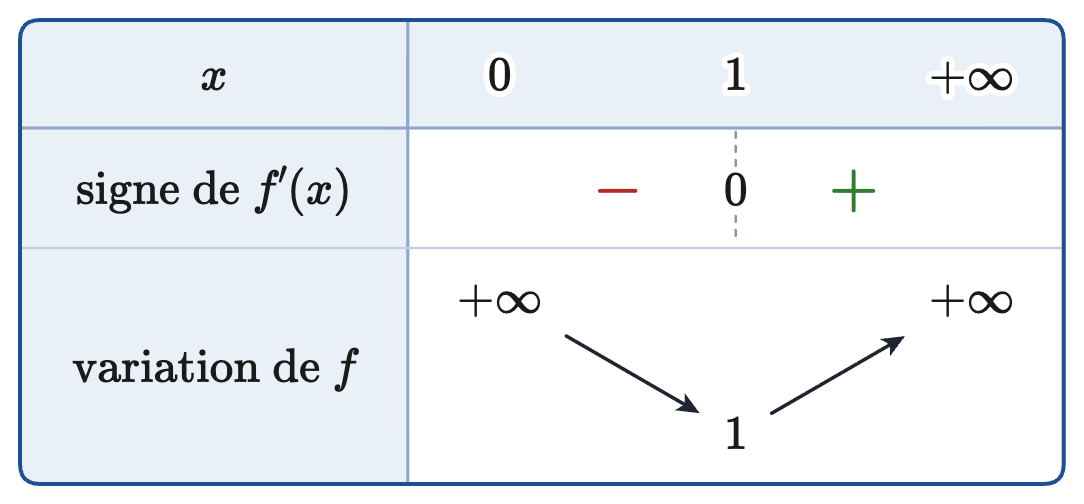
Déterminer les limites de ff en 00 et en +∞+\infty, puis dresser son tableau de variation.

Correction
  • lim⁡x→+∞ln⁡(x)x=0\lim\limits_{x\to +\infty } \dfrac{\ln \left(x\right)}{x}=0 (croissance comparée)
Limite en 0\red{\text{Limite en }0}
lim⁡x→0+ln⁡(x)=−∞\lim\limits_{x\to 0^{+}} \ln \left(x\right)=-\infty donc lim⁡x→0+−ln⁡(x)=+∞\lim\limits_{x\to 0^{+}} -\ln \left(x\right)=+\infty ; de plus lim⁡x→0+x=0\lim\limits_{x\to 0^{+}} x=0. Par somme :
lim⁡x→0+f(x)=+∞\lim\limits_{x\to 0^{+}} f\left(x\right)=+\infty

Limite en +∞\red{\text{Limite en }+\infty}
On a une forme indéterminée « +∞−∞+\infty -\infty ». Pour tout réel x>0x\gt 0, on factorise par xx :
f(x)=x(1−ln⁡(x)x)f\left(x\right)=x\left(1-\dfrac{\ln \left(x\right)}{x}\right)
Or lim⁡x→+∞ln⁡(x)x=0\lim\limits_{x\to +\infty } \dfrac{\ln \left(x\right)}{x}=0 donc lim⁡x→+∞1−ln⁡(x)x=1\lim\limits_{x\to +\infty } 1-\dfrac{\ln \left(x\right)}{x}=1, et lim⁡x→+∞x=+∞\lim\limits_{x\to +\infty } x=+\infty. Par produit :
lim⁡x→+∞f(x)=+∞\lim\limits_{x\to +\infty } f\left(x\right)=+\infty

Variations\red{\text{Variations}}
La fonction ff est dérivable sur ]0;+∞[\left]0;+\infty \right[ et, pour tout réel x>0x\gt 0 :
f′(x)=1−1xf'\left(x\right)=1-\dfrac{1}{x}
f′(x)=x−1xf'\left(x\right)=\dfrac{x-1}{x}

Pour tout réel x>0x\gt 0, x>0x\gt 0 donc le signe de f′(x)f'\left(x\right) est celui de x−1x-1. Il en résulte donc que :
  • si x∈]0;1[x\in \left]0;1\right[ alors f′(x)<0f'\left(x\right)\lt 0 et donc ff est strictement décroissante sur ]0;1]\left]0;1\right] ;
  • si x∈]1;+∞[x\in \left]1;+\infty \right[ alors f′(x)>0f'\left(x\right)\gt 0 et donc ff est strictement croissante sur [1;+∞[\left[1;+\infty \right[.
De plus f(1)=1−ln⁡(1)=1f\left(1\right)=1-\ln \left(1\right)=1. Nous traduisons toutes ces informations dans le tableau de variation ci-dessous :
Question 2

Soit n≥2n\ge 2. Démontrer que l'équation f(x)=nf\left(x\right)=n admet exactement deux solutions sur ]0;+∞[\left]0;+\infty \right[, notées ana_{n} et bnb_{n}, avec 0<an<1<bn0\lt a_{n}\lt 1\lt b_{n}.

Correction
  • Corollaire du théorème des valeurs intermédiaires : si ff est continue et strictement monotone sur un intervalle II, alors, pour tout réel kk compris strictement entre les limites (ou les valeurs) de ff aux bornes de II, l'équation f(x)=kf\left(x\right)=k admet une unique solution dans II.
Soit n≥2n\ge 2. La fonction ff est continue sur ]0;+∞[\left]0;+\infty \right[ car elle y est dérivable.
Sur l’intervalle ]0;1]\red{\text{Sur l'intervalle }\left]0;1\right]}
La fonction ff est continue et strictement décroissante sur ]0;1]\left]0;1\right], avec lim⁡x→0+f(x)=+∞\lim\limits_{x\to 0^{+}} f\left(x\right)=+\infty et f(1)=1f\left(1\right)=1. Comme n>1n\gt 1, nn est compris strictement entre 11 et +∞+\infty : d'après le corollaire du théorème des valeurs intermédiaires, l'équation f(x)=nf\left(x\right)=n admet une unique solution ana_{n} dans ]0;1]\left]0;1\right]. Comme f(1)=1f\left(1\right)=1 et n>1n\gt 1, on a an≠1a_{n}\neq 1, donc
0<an<10\lt a_{n}\lt 1

Sur l’intervalle [1;+∞[\red{\text{Sur l'intervalle }\left[1;+\infty \right[}
De même, la fonction ff est continue et strictement croissante sur [1;+∞[\left[1;+\infty \right[, avec f(1)=1f\left(1\right)=1 et lim⁡x→+∞f(x)=+∞\lim\limits_{x\to +\infty } f\left(x\right)=+\infty : l'équation f(x)=nf\left(x\right)=n admet une unique solution bnb_{n} dans [1;+∞[\left[1;+\infty \right[, et bn≠1b_{n}\neq 1, donc
bn>1b_{n}\gt 1

L'équation f(x)=nf\left(x\right)=n admet donc exactement deux solutions sur ]0;+∞[\left]0;+\infty \right[ : ana_{n} et bnb_{n}, avec 0<an<1<bn0\lt a_{n}\lt 1\lt b_{n}.
Question 3

Démontrer que la suite (an)\left(a_{n}\right) est strictement décroissante et que la suite (bn)\left(b_{n}\right) est strictement croissante.

Correction
Soit n≥2n\ge 2. On a f(an+1)=n+1>n=f(an)f\left(a_{n+1}\right)=n+1\gt n=f\left(a_{n}\right), avec ana_{n} et an+1a_{n+1} dans ]0;1]\left]0;1\right].
Raisonnons par l'absurde : si l'on avait an+1≥ana_{n+1}\ge a_{n}, la fonction ff étant décroissante sur ]0;1]\left]0;1\right], on aurait f(an+1)≤f(an)f\left(a_{n+1}\right)\le f\left(a_{n}\right), ce qui est faux. Ainsi :
an+1<ana_{n+1}\lt a_{n}

De même, f(bn+1)=n+1>n=f(bn)f\left(b_{n+1}\right)=n+1\gt n=f\left(b_{n}\right), avec bnb_{n} et bn+1b_{n+1} dans [1;+∞[\left[1;+\infty \right[. Si l'on avait bn+1≤bnb_{n+1}\le b_{n}, la fonction ff étant croissante sur [1;+∞[\left[1;+\infty \right[, on aurait f(bn+1)≤f(bn)f\left(b_{n+1}\right)\le f\left(b_{n}\right), ce qui est faux. Ainsi :
bn<bn+1b_{n}\lt b_{n+1}

La suite (an)\left(a_{n}\right) est strictement décroissante et la suite (bn)\left(b_{n}\right) est strictement croissante.
Question 4
Partie B : comportement de bnb_{n}

Démontrer que, pour tout entier n≥2n\ge 2 : n<bn<2nn\lt b_{n}\lt 2n.
On pourra étudier la fonction gg définie sur [1;+∞[\left[1;+\infty \right[ par g(x)=x−ln⁡(2x)g\left(x\right)=x-\ln \left(2x\right).

Correction
Soit n≥2n\ge 2.
Minoration\red{\text{Minoration}}
Par définition, bn−ln⁡(bn)=nb_{n}-\ln \left(b_{n}\right)=n, donc bn=n+ln⁡(bn)b_{n}=n+\ln \left(b_{n}\right). Or bn>1b_{n}\gt 1 donc ln⁡(bn)>0\ln \left(b_{n}\right)\gt 0, d'où :
bn>nb_{n}\gt n

Majoration\red{\text{Majoration}}
La fonction gg est dérivable sur [1;+∞[\left[1;+\infty \right[ et, pour tout réel x≥1x\ge 1 :
g′(x)=1−22x=1−1x=x−1xg'\left(x\right)=1-\dfrac{2}{2x}=1-\dfrac{1}{x}=\dfrac{x-1}{x}
donc g′(x)≥0g'\left(x\right)\ge 0 : la fonction gg est croissante sur [1;+∞[\left[1;+\infty \right[. Comme g(1)=1−ln⁡(2)>0g\left(1\right)=1-\ln \left(2\right)\gt 0, pour tout réel x≥1x\ge 1, g(x)≥g(1)>0g\left(x\right)\ge g\left(1\right)\gt 0, c'est-à-dire x>ln⁡(2x)x\gt \ln \left(2x\right).
Avec x=nx=n : n>ln⁡(2n)n\gt \ln \left(2n\right), donc :
f(2n)=2n−ln⁡(2n)>2n−n=nf\left(2n\right)=2n-\ln \left(2n\right)\gt 2n-n=n
Ainsi f(2n)>n=f(bn)f\left(2n\right)\gt n=f\left(b_{n}\right), avec 2n2n et bnb_{n} dans [1;+∞[\left[1;+\infty \right[. Si l'on avait bn≥2nb_{n}\ge 2n, la fonction ff étant croissante sur [1;+∞[\left[1;+\infty \right[, on aurait f(bn)≥f(2n)f\left(b_{n}\right)\ge f\left(2n\right), ce qui est faux. D'où :
bn<2nb_{n}\lt 2n

Ainsi, pour tout entier n≥2n\ge 2 :
n<bn<2nn\lt b_{n}\lt 2n
Question 5

En déduire la limite de la suite (bn)\left(b_{n}\right), puis démontrer que lim⁡n→+∞bnn=1\lim\limits_{n\to +\infty } \dfrac{b_{n}}{n}=1.

Correction
  • Théorème de comparaison : si, à partir d'un certain rang, un≥vnu_{n}\ge v_{n} et si lim⁡n→+∞vn=+∞\lim\limits_{n\to +\infty } v_{n}=+\infty, alors lim⁡n→+∞un=+∞\lim\limits_{n\to +\infty } u_{n}=+\infty.
Pour tout entier n≥2n\ge 2, bn>nb_{n}\gt n et lim⁡n→+∞n=+∞\lim\limits_{n\to +\infty } n=+\infty. D'après le théorème de comparaison :
lim⁡n→+∞bn=+∞\lim\limits_{n\to +\infty } b_{n}=+\infty
  • Théorème des gendarmes : si, à partir d'un certain rang, vn≤un≤wnv_{n}\le u_{n}\le w_{n} et si (vn)\left(v_{n}\right) et (wn)\left(w_{n}\right) convergent vers la même limite ℓ\ell, alors (un)\left(u_{n}\right) converge vers ℓ\ell.
Soit n≥2n\ge 2. Comme bn=n+ln⁡(bn)b_{n}=n+\ln \left(b_{n}\right) : bnn=1+ln⁡(bn)n\dfrac{b_{n}}{n}=1+\dfrac{\ln \left(b_{n}\right)}{n}.
D'après la question 44, 1<n<bn<2n1\lt n\lt b_{n}\lt 2n. La fonction ln⁡\ln étant strictement croissante : 0<ln⁡(bn)<ln⁡(2n)0\lt \ln \left(b_{n}\right)\lt \ln \left(2n\right), donc :
1<bnn<1+ln⁡(2n)n1\lt \dfrac{b_{n}}{n}\lt 1+\dfrac{\ln \left(2n\right)}{n}
Or ln⁡(2n)n=2×ln⁡(2n)2n\dfrac{\ln \left(2n\right)}{n}=2\times \dfrac{\ln \left(2n\right)}{2n} et, en posant X=2nX=2n, lim⁡X→+∞ln⁡(X)X=0\lim\limits_{X\to +\infty } \dfrac{\ln \left(X\right)}{X}=0 (croissance comparée), donc lim⁡n→+∞1+ln⁡(2n)n=1\lim\limits_{n\to +\infty } 1+\dfrac{\ln \left(2n\right)}{n}=1. D'après le théorème des gendarmes :
lim⁡n→+∞bnn=1\lim\limits_{n\to +\infty } \dfrac{b_{n}}{n}=1
Question 6

Démontrer que lim⁡n→+∞(bn−n−ln⁡(n))=0\lim\limits_{n\to +\infty } \left(b_{n}-n-\ln \left(n\right)\right)=0. Interpréter ce résultat.

Correction
Soit n≥2n\ge 2. Comme bn−n=ln⁡(bn)b_{n}-n=\ln \left(b_{n}\right) :
bn−n−ln⁡(n)=ln⁡(bn)−ln⁡(n)b_{n}-n-\ln \left(n\right)=\ln \left(b_{n}\right)-\ln \left(n\right)
bn−n−ln⁡(n)=ln⁡(bnn)b_{n}-n-\ln \left(n\right)=\ln \left(\dfrac{b_{n}}{n}\right)

D'après la question 55, lim⁡n→+∞bnn=1\lim\limits_{n\to +\infty } \dfrac{b_{n}}{n}=1, et la fonction ln⁡\ln est continue en 11, donc, par composition :
lim⁡n→+∞(bn−n−ln⁡(n))=ln⁡(1)=0\lim\limits_{n\to +\infty } \left(b_{n}-n-\ln \left(n\right)\right)=\ln \left(1\right)=0

Ainsi bn=n+ln⁡(n)+εnb_{n}=n+\ln \left(n\right)+\varepsilon_{n} avec lim⁡n→+∞εn=0\lim\limits_{n\to +\infty } \varepsilon_{n}=0 : lorsque nn devient grand, bnb_{n} est très proche de n+ln⁡(n)n+\ln \left(n\right). Par exemple, à la calculatrice, b10≈12,53b_{10}\approx 12{,}53 alors que 10+ln⁡(10)≈12,3010+\ln \left(10\right)\approx 12{,}30.
Question 7
Partie C : comportement de ana_{n}

Démontrer que, pour tout entier n≥2n\ge 2 : an=ean−na_{n}=e^{a_{n}-n}, puis que e−n<an<e1−ne^{-n}\lt a_{n}\lt e^{1-n}. En déduire la limite de la suite (an)\left(a_{n}\right).

Correction
Soit n≥2n\ge 2. Par définition, an−ln⁡(an)=na_{n}-\ln \left(a_{n}\right)=n, donc ln⁡(an)=an−n\ln \left(a_{n}\right)=a_{n}-n. Comme an>0a_{n}\gt 0, an=eln⁡(an)a_{n}=e^{\ln \left(a_{n}\right)}, d'où :
an=ean−na_{n}=e^{a_{n}-n}

D'après la question 22, 0<an<10\lt a_{n}\lt 1, donc −n<an−n<1−n-n\lt a_{n}-n\lt 1-n. La fonction exponentielle étant strictement croissante sur R\mathbb{R} :
e−n<ean−n<e1−ne^{-n}\lt e^{a_{n}-n}\lt e^{1-n}
Ainsi :
e−n<an<e1−ne^{-n}\lt a_{n}\lt e^{1-n}
  • Théorème des gendarmes : si, à partir d'un certain rang, vn≤un≤wnv_{n}\le u_{n}\le w_{n} et si (vn)\left(v_{n}\right) et (wn)\left(w_{n}\right) convergent vers la même limite ℓ\ell, alors (un)\left(u_{n}\right) converge vers ℓ\ell.
Or lim⁡n→+∞−n=−∞\lim\limits_{n\to +\infty } -n=-\infty et lim⁡X→−∞eX=0\lim\limits_{X\to -\infty } e^{X}=0 donc, par composition, lim⁡n→+∞e−n=0\lim\limits_{n\to +\infty } e^{-n}=0 ; de même, lim⁡n→+∞e1−n=0\lim\limits_{n\to +\infty } e^{1-n}=0. D'après le théorème des gendarmes :
lim⁡n→+∞an=0\lim\limits_{n\to +\infty } a_{n}=0
Question 8

Démontrer que lim⁡n→+∞anen=1\lim\limits_{n\to +\infty } a_{n}e^{n}=1. Commenter les comportements des suites (an)\left(a_{n}\right) et (bn)\left(b_{n}\right).

Correction
Soit n≥2n\ge 2. D'après la question 77 :
anen=ean−n×en=eana_{n}e^{n}=e^{a_{n}-n}\times e^{n}=e^{a_{n}}
Or lim⁡n→+∞an=0\lim\limits_{n\to +\infty } a_{n}=0 et la fonction exponentielle est continue en 00, donc, par composition :
lim⁡n→+∞anen=e0=1\lim\limits_{n\to +\infty } a_{n}e^{n}=e^{0}=1

Commentaire\red{\text{Commentaire}}
Lorsque nn devient grand, ana_{n} est très proche de e−ne^{-n} : la suite (an)\left(a_{n}\right) tend vers 00 extrêmement vite (à la calculatrice, a10≈4,540×10−5a_{10}\approx 4{,}540\times 10^{-5} et e−10≈4,540×10−5e^{-10}\approx 4{,}540\times 10^{-5}). Au contraire, bnb_{n} est proche de n+ln⁡(n)n+\ln \left(n\right) et tend vers +∞+\infty à peu près comme nn. Les deux solutions de l'équation x−ln⁡(x)=nx-\ln \left(x\right)=n s'éloignent donc l'une vers 00 et l'autre vers +∞+\infty, mais à des vitesses très différentes.

Signaler une erreur

Aide-nous à améliorer nos contenus en signalant les erreurs ou problèmes que tu penses avoir trouvés.

Connecte-toi ou crée un compte pour signaler une erreur.